
Menopause
How to Build a Balanced Diet for Gut Health in Jersey City, NJ
May 9, 2026 · Julia Erickson
How to Build a Balanced Diet for Gut Health in Jersey City, NJ
Most gut health conversations get stuck in ingredient lists. Eat more kimchi. Add more fiber. Take a probiotic. These are useful starting points, but they miss the larger picture: building a balanced diet for gut health is really about architecture. It is about how you structure your plate, how you rotate your foods across the week, and how those choices compound over time into a microbiome that is genuinely resilient.
If you live or work in Jersey City, you are in an unusually good position to get this right. The city's food culture gives you access to ingredients and culinary traditions from across the world, and as you will see, diversity of food sources is not a nice-to-have. It is the point.
Why Diversity Is the Core Principle
Before getting into what to eat, it helps to understand why variety matters more than any single food.
The research from the American Gut Project, a large-scale citizen science study involving more than 10,000 participants across the US, UK, and Australia, found that people who ate 30 different plant types per week had significantly more diverse gut microbiomes than those who ate 10 or fewer. The finding held regardless of whether someone called themselves vegan, vegetarian, or omnivore. Dietary category mattered far less than plant diversity.
Why does this matter? Because different species of gut bacteria feed on different types of fiber, resistant starch, and polyphenols. A monoculture of foods produces a monoculture of bacteria. A diverse plate feeds a diverse community, and a diverse microbial community is associated with stronger immune function, reduced inflammation, and more stable mood and energy.
The British Nutrition Foundation notes that typical western diets, low in fiber and plant variety, are linked to reduced microbial diversity and a shift away from beneficial bacterial strains. The fiber shortfall is real: recommended intake is 30 grams per day, and most people consume significantly less.
Thirty plant foods per week sounds ambitious. In practice, it is more approachable than it seems, especially in a city with the culinary range of Jersey City.
The 4 Categories Every Gut-Health Plate Needs
A well-built gut-health plate draws from four functional categories. You do not need all four at every meal, but across the day you want representation from each one.
Fiber-Rich Plants (Prebiotic Foundation)
Prebiotic foods are the fuel for beneficial gut bacteria. They are indigestible fibers that pass through the small intestine and ferment in the colon, feeding microbial communities. Key sources include garlic, onions, leeks, asparagus, chicory root, green bananas, Jerusalem artichokes, and oats.
The goal is not just quantity but variety. Different prebiotic fibers (inulin, FOS, pectin, beta-glucan) feed different bacterial populations. Rotating between root vegetables, alliums, legumes, and whole grains ensures broad coverage.
Half your plate at most meals should be plant foods of at least two or three different colors. Color diversity signals polyphenol diversity, which also feeds the microbiome.
Fermented and Probiotic Foods (Live Cultures)
These foods deliver live microorganisms that can temporarily contribute to the microbial community in your gut. Think plain yogurt with active cultures, kefir, sauerkraut, kimchi, miso, tempeh, and kombucha.
The key is regularity and rotation. Eating the same fermented food every day is less useful than rotating between two or three sources, since different foods carry different strains. A small serving daily, roughly 60 to 100 grams, is enough to have an effect without overwhelming digestion.
If you are new to fermented foods, start with one serving daily and increase gradually. The fermented foods beginner's guide in Caldwell, NJ covers how to start if this territory is unfamiliar. For a deeper look at what makes a food genuinely probiotic versus simply fermented, the post on probiotic foods in Jersey City covers strain specificity and how to read labels.
Omega-3 Rich Foods (Anti-Inflammatory Support)
Chronic low-grade gut inflammation is one of the most common obstacles to microbiome health. Omega-3 fatty acids from food sources help modulate inflammatory pathways and have been shown to support beneficial bacterial populations including Akkermansia and Lactobacillus species.
Primary food sources: wild salmon, sardines, mackerel, anchovies, walnuts, ground flaxseed, chia seeds, and hemp seeds. Aim for fatty fish two to three times per week. On days without fish, walnuts or ground flaxseed added to oatmeal or a smoothie cover the plant-based side.
This is also the category that interacts most directly with hormonal health. Healthy fats are structural components of cell membranes and precursors to hormone production. If you are also working on balancing hormones naturally, omega-3 rich foods are doing double duty on your plate.
Polyphenol-Rich Foods (Microbiome Diversity Feeders)
Polyphenols are plant compounds found in colorful fruits and vegetables, dark chocolate, green tea, coffee, red wine in moderation, extra virgin olive oil, and berries. They act as fertilizer for beneficial bacterial species, particularly Bifidobacterium and Akkermansia.
Polyphenols do not always get the attention prebiotics do, but research increasingly shows them as central to microbiome diversity. The simplest daily source is extra virgin olive oil as your primary cooking fat, berries with breakfast, and green tea instead of a second cup of coffee.
For a broader view of how eating the rainbow supports these polyphenol goals, that post covers why color variety in plants signals microbial benefit.
How to Build the Balanced Plate
With the four categories in place, here is the plate architecture that brings them together:
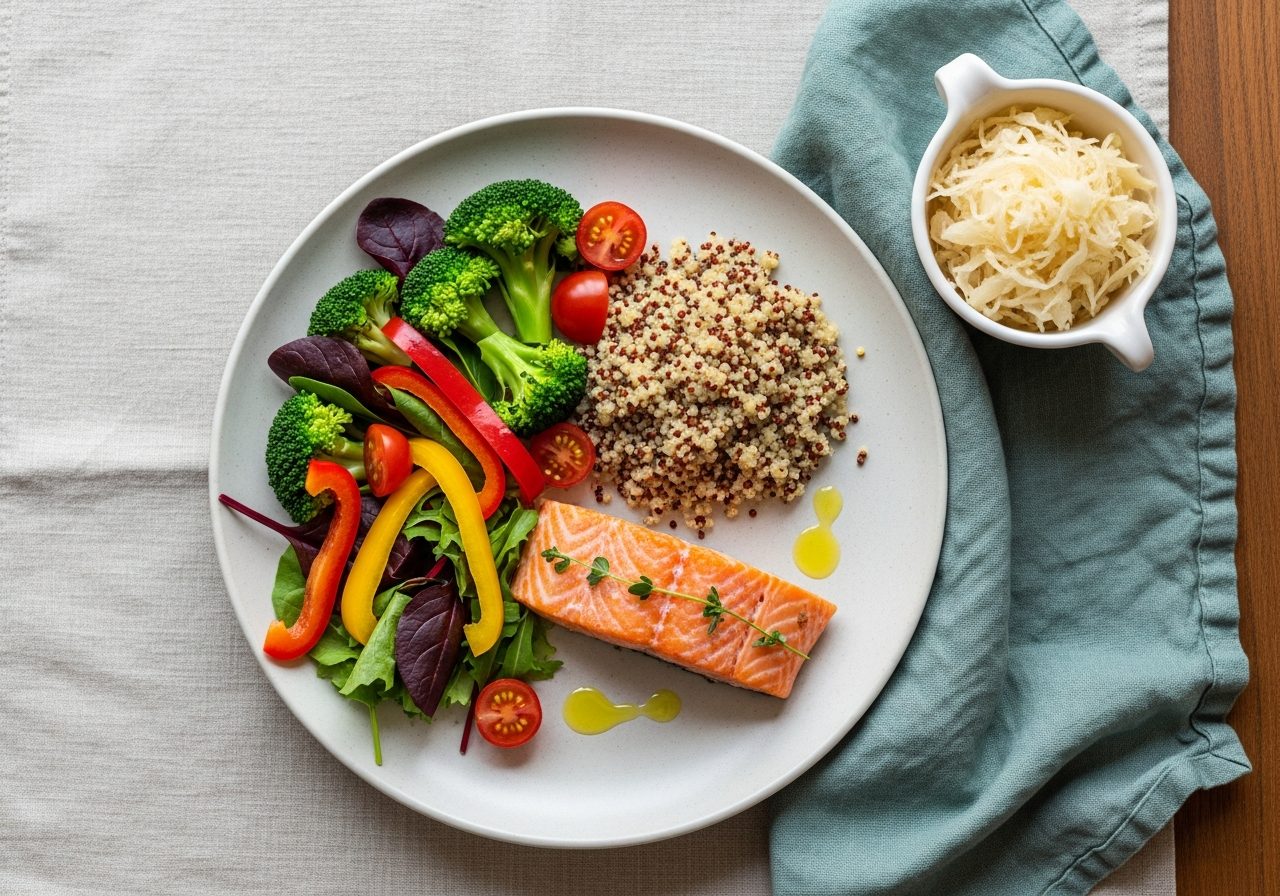
- Half the plate: mixed colorful vegetables and/or legumes (two or more varieties, different colors)
- One quarter: quality protein (wild fish, pastured chicken, legumes, eggs, or tofu)
- One quarter: whole grain or legume base (quinoa, wild rice, lentils, black beans, farro)
- Small fermented side: a tablespoon of sauerkraut, a small cup of kefir, or a spoonful of miso stirred into dressing
- Healthy fat finish: drizzle of extra virgin olive oil, a few walnuts, or sliced avocado
This structure is not a rigid formula. It is a proportional guide. Some meals will naturally lean heavier on vegetables. Others might center on a grain bowl with legumes doing dual duty as protein and fiber. The important thing is that across the day, all four categories show up.
A Sample Weekly Rhythm
Hitting 30 plant foods per week does not require elaborate meal planning. It requires intentional variety rather than repetition. Here is a rough weekly rotation that achieves it without stress:
Monday and Tuesday draw from the same base: oats with ground flaxseed, walnuts, and berries at breakfast. Lunch rotates between a grain bowl with a different grain each day (quinoa one day, farro the next). Dinner builds around wild fish or legumes with two vegetable sides of different colors.
Wednesday introduces one completely new plant: an unfamiliar grain, a root vegetable you do not usually buy, or a new leafy green. Jersey City's International and Korean markets in the Journal Square area are particularly good for this, with vegetables like burdock root, lotus root, and Korean perilla that most grocery stores do not carry.
Thursday and Friday lean on legumes: lentil soup, black bean tacos, chickpea salad. Legumes count as one plant food per species, so rotating between chickpeas, lentils, black beans, and kidney beans adds four plants almost automatically.
Saturday is a good day for variety: a market visit, a new ethnic cuisine, or a homemade grain salad that uses three or four types of seeds and grains mixed together. Seeds count individually, so a salad with pumpkin seeds, sesame seeds, and sunflower seeds adds three plants before you have touched the vegetables.
Sunday tends to be a reset: a simple vegetable-forward soup using whatever produce needs to be used up. This is often where you clear the week's remaining plant variety and comfortably hit 30 without counting.
Common Pitfalls That Undermine a Gut-Healthy Diet
A few patterns consistently derail otherwise good intentions:
Relying on supplements over food is the most common. Probiotic supplements are useful in specific contexts, but they cannot replicate the synergistic effect of eating whole fermented foods with fiber alongside them. Whole foods come with co-factors that supplements do not.
Ignoring fiber while focusing on fermented foods is equally limiting. Probiotic foods populate the gut temporarily. Prebiotic fiber feeds the bacteria already there. You need both.
Overdoing fermented foods is less common but real. Starting with large amounts of kimchi or kefir when the gut is not accustomed to it can cause bloating and discomfort. The goal is a small serving daily, rotating sources, not loading up on one fermented food.
Timing and Hydration Matter Too
Forgetting hydration undermines everything else. Fiber absorbs water. Without adequate hydration (roughly two liters of water daily as a baseline, more in warm weather), fiber-rich diets can cause constipation rather than prevent it.
Eating too late and skipping the fasting window matters more than most people realize. A 12-hour overnight fast, finishing dinner by 8pm and not eating until 8am, allows the gut to activate its migrating motor complex, a cleansing wave that sweeps the intestines. Frequent eating or late snacking interrupts this repair cycle.
Special Considerations
For people managing IBS or other digestive conditions, the standard gut-health plate needs modification. High-FODMAP foods (garlic, onions, certain legumes, some fruits) trigger symptoms in sensitive individuals even though they are otherwise excellent prebiotic sources. Monash University, which developed the FODMAP framework, recommends a structured three-phase elimination and reintroduction process to identify individual triggers rather than blanket avoidance.
For those with dairy intolerance, fermented dairy can sometimes be tolerated because the lactose is partially broken down during fermentation. Kefir, for instance, contains significantly less lactose than fresh milk. If dairy is off the table entirely, coconut kefir, water kefir, and fermented vegetables cover the probiotic category without compromise.
Plant-based diets can be extraordinarily gut-supportive if built around legume and grain diversity. The risk is relying too heavily on the same few plants, particularly wheat, soy, and corn, without rotating. The 30-plant principle matters especially for plant-based eaters who might otherwise fall into a repetitive pattern.
Building This in Jersey City
Jersey City's culinary range makes the 30-plant goal unusually achievable. The Korean community's contribution of properly fermented kimchi, the Eastern European markets with cultured dairy and lacto-fermented vegetables, the South Asian and Middle Eastern grocers stocking lentil varieties, spices, and grains that most chains do not carry: all of these translate directly into microbiome diversity.
A gut-healthy diet built here does not have to be precious or expensive. It can look like a bowl of dal with turmeric and three vegetable sides, or miso-glazed salmon over quinoa with a fermented side. The structure is simple. The diversity does the work.
Jolie's clients throughout Northern NJ often find that the biggest shift is not adding more foods but rotating what they already eat more deliberately. Once the plate architecture is clear, the 30-plant week takes care of itself.
If you are starting with fermented foods specifically, the gut health food guide for Weehawken covers the broader food categories in more depth. The foundation you build now, one varied plate at a time, is what makes lasting gut health possible. Begin here.
Looking for personalized, science-based support in Jersey City? Explore Jolie's wellness programs in Northern New Jersey.