
Menopause
Probiotic Foods for Gut Health in Jersey City, NJ
May 17, 2026 · Julia Erickson
Probiotic Foods for Gut Health in Jersey City, NJ
Jersey City's food scene reflects a depth of culinary tradition that most cities cannot match. Korean markets in the Journal Square area carry jars of properly fermented kimchi made without vinegar shortcuts. Eastern European and Polish delis stock their own versions of lacto-fermented pickles and cultured dairy. Latin American grocers bring in crema fresca and kefir-adjacent cultured drinks.
If you want real probiotic foods for gut health, Jersey City is one of the best places in Northern NJ to find them. The challenge is knowing exactly what qualifies as probiotic and what is simply fermented.
Those two categories overlap, but they are not the same thing. Understanding the distinction is the first step toward building a diet that genuinely moves the needle for your gut.
What "Probiotic" Actually Means
The word gets used loosely, which creates confusion. The scientifically accepted definition, established by ISAPP (the International Scientific Association for Probiotics and Prebiotics), is precise: probiotics are live microorganisms that, when administered in adequate amounts, confer a health benefit on the host.
Three things matter in that definition. First, the organisms must be alive. Second, they must be present in sufficient quantities to actually do something (this is the concept behind CFU, or colony-forming units, the standard measure of viable bacteria in a dose). Third, the specific strain must have documented evidence of a health benefit.
A product that simply contains live bacteria but lacks that third element is a fermented food, not a probiotic in the clinical sense.
This distinction is not just academic. It matters when you are standing in a grocery aisle deciding between two jars of yogurt, or choosing whether to reach for fermented food or a targeted supplement.
Probiotic vs. Prebiotic vs. Postbiotic
These three terms now appear on packaging everywhere, and they describe three different things.
Probiotics are the live bacteria themselves. Prebiotics are the plant fibers that feed beneficial bacteria already living in your gut. Postbiotics are the byproducts that bacteria produce during fermentation: organic acids, enzymes, short-chain fatty acids, and cellular components that also carry health benefits. A well-designed gut protocol addresses all three, which is why food-first approaches tend to outperform supplements alone.
For a deeper look at the food categories that support your microbiome beyond live cultures, the post on gut-supportive food categories covers prebiotics, omega-3s, and polyphenols as part of the larger picture. This post focuses tightly on the probiotic category itself.
The Live Culture Distinction: Why Pasteurization Matters
Here is where the shelf matters, literally. Pasteurization uses heat to extend shelf life. It also destroys live cultures. Sauerkraut from a shelf-stable can, vinegar-pickled cucumbers from a commercial jar, and kombucha that has been heat-treated do not contain meaningful probiotic activity regardless of what the front label implies.
The practical rule: refrigerated fermented foods are far more likely to contain live and active cultures than their shelf-stable counterparts. Raw, unpasteurized sauerkraut will be found in the refrigerated section, often near deli items or alongside fermented condiments. Kefir lives in the dairy case. Miso and traditionally fermented natto are refrigerated in Asian grocery stores.
This is also why heat kills what you are trying to preserve. Adding miso to boiling broth, cooking kimchi at high temperature, or stirring live yogurt into a hot pan eliminates the probiotic benefit. These foods are most valuable eaten raw or added to dishes after the heat source is removed.
Key Probiotic Food Categories
Dairy Ferments: Yogurt and Kefir
Yogurt is the most accessible probiotic food in any grocery store. What distinguishes a genuinely probiotic yogurt from a pasteurized dairy product is the presence of live Lactobacillus and Streptococcus strains added after heat treatment. Look for the words "live and active cultures" on the label, not just "contains cultures." Plain, full-fat yogurt without added sugar is the cleanest form.
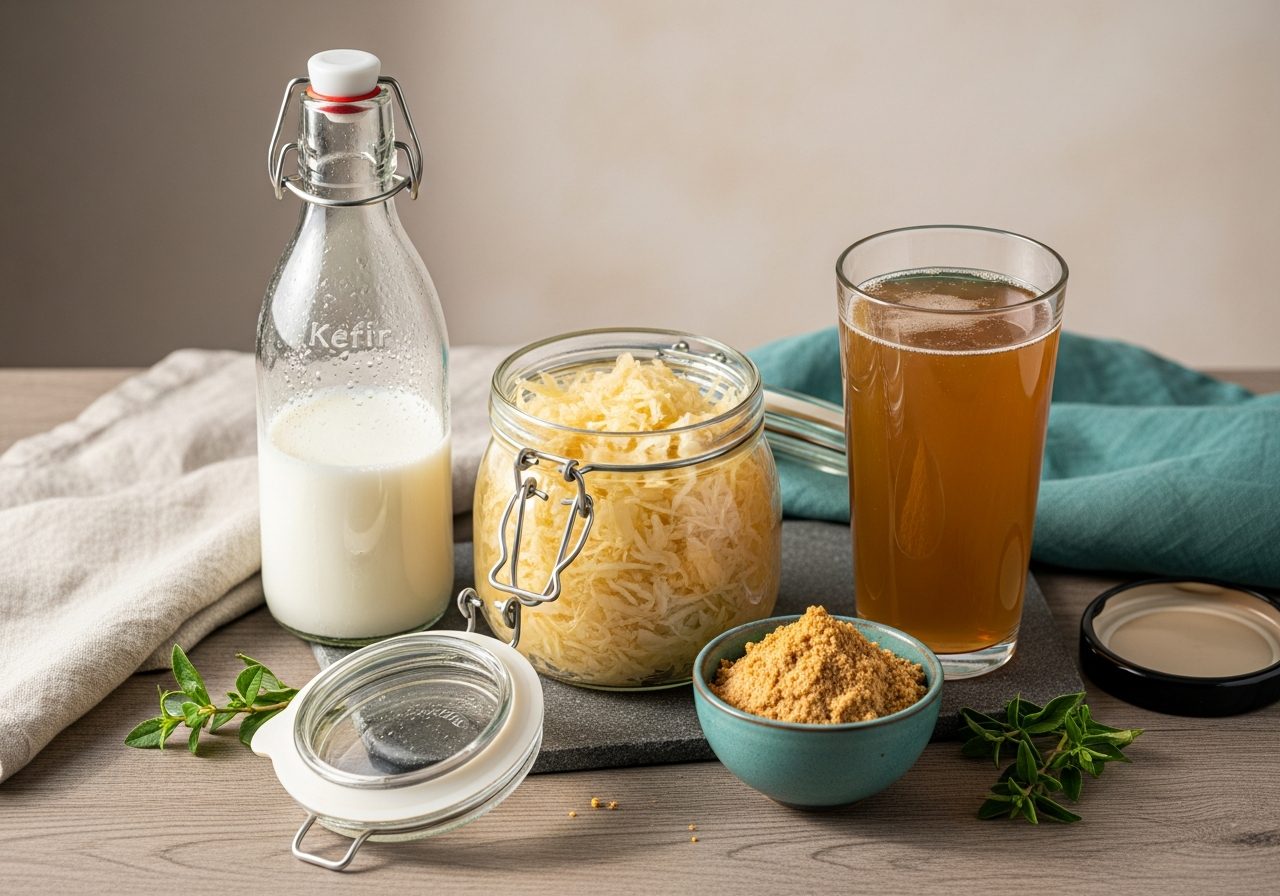
Kefir offers more strain diversity than most yogurts. A quality kefir contains both bacterial cultures and beneficial yeasts, including Lactobacillus kefiri, Lactococcus lactis, and Saccharomyces cerevisiae. This variety makes kefir one of the most complex probiotic foods available without a prescription.
Vegetable Ferments: Sauerkraut, Kimchi, and Fermented Pickles
Properly lacto-fermented vegetables (made with salt and time, not vinegar and heat) are excellent sources of Lactobacillus strains. Sauerkraut is consistently studied and consistently delivers Lactobacillus plantarum. Kimchi, given Jersey City's well-established Korean community, is easy to source in quality from local markets. Traditionally made kimchi contains a broader mix of strains, including Lactobacillus sakei, which research has associated with immune modulation.
Fermented pickles made without vinegar (look for "naturally fermented" or "lacto-fermented" on the label) carry the same benefits. Commercially pickled cucumbers in vinegar brine are not the same food.
Miso, Natto, and Tempeh
These soy-based ferments are staples of Japanese cuisine and carry distinct probiotic profiles. Miso contains Aspergillus oryzae and lactobacillus strains developed over weeks or months of fermentation. Natto is one of the highest food sources of Bacillus subtilis natto, a strain with specific research behind cardiovascular and gut benefits. Tempeh, made from fermented whole soybeans, has a firmer texture and different microbial profile than miso.
All three are best sourced from stores that carry them refrigerated and with clear fermentation labeling.
Probiotic Drinks: Kombucha, Water Kefir, and Traditional Kvass
Kombucha is fermented sweet tea, made with a SCOBY (symbiotic culture of bacteria and yeast). The probiotic content of commercial kombucha varies widely depending on whether the brand heat-processes its product after fermentation. Raw, unpasteurized kombucha found in the refrigerated section contains live cultures; pasteurized kombucha does not.
Water kefir is a lighter-tasting, dairy-free alternative made by fermenting sugar water or coconut water with water kefir grains. It delivers a different microbial community than milk kefir. Traditional kvass, common in Eastern European stores in Jersey City, is fermented bread or beet-based and may carry modest probiotic content, though it is less studied than the above options.
Strain-Specific Benefits: A Brief Guide
Not every probiotic strain does the same thing, and this is where the science gets genuinely useful.
- Lactobacillus rhamnosus GG is one of the most researched strains in clinical literature, with consistent associations with reduction in antibiotic-associated diarrhea and support for children's digestive health.
- Bifidobacterium lactis has been studied for immune modulation, and appears in several yogurt brands sold in major grocery stores.
- Saccharomyces boulardii is a beneficial yeast (not a bacterium) associated with traveler's diarrhea prevention and gut resilience during antibiotic treatment. It appears in some fermented drinks and in targeted supplements.
Most food labels do not specify strain designations to this level of detail, which is one reason supplementation sometimes makes more sense than food alone for clinical goals.
When Food Is Enough and When It Is Not
Probiotic foods deliver a broad, diverse stream of live organisms regularly. That regularity matters: your gut microbiome responds to consistent input. Someone eating a small serving of kefir, a tablespoon of sauerkraut, and a miso-based broth most days is doing meaningful work for their microbiome over time, without ever needing a supplement.
However, ISAPP and the American Gastroenterological Association note that specific clinical goals, such as preventing antibiotic-associated diarrhea, managing pouchitis, or recovering from gut dysbiosis, often require targeted strains at documented doses that food cannot reliably deliver. A supplement designed around Lactobacillus rhamnosus GG or a high-dose Saccharomyces boulardii product can achieve specific outcomes in ways that even excellent probiotic foods cannot.
The practical answer: food first, for foundational ongoing support. Supplements for targeted, time-limited clinical needs. And before choosing a probiotic supplement, it is worth reviewing the context on probiotics ruining your gut before choosing a product.
How to Start Without Overwhelming Your System
The most common early mistake is too much, too fast. When your microbiome is out of balance, introducing large quantities of new bacterial strains triggers fermentation activity that can feel like bloating, loose stools, or increased gas. This is not a sign the food is wrong. It is your gut adjusting.
Start with one serving of one probiotic food per day, with a meal. A few tablespoons of yogurt, a small pour of kefir in a smoothie, a spoonful of sauerkraut alongside dinner. Observe how your digestion responds over a week before adding a second source. Rotating between probiotic food categories over time (dairy ferments one week, vegetable ferments the next, miso and drinks to follow) builds a more diverse microbial community than relying on one source indefinitely.
Your gut health does not exist in isolation. The connection between your microbiome and hormonal balance is close enough that gut inflammation can directly disrupt estrogen clearance and cortisol regulation. The post on hormone-balancing foods connects those dots if you want to look at both systems together.
Building a Probiotic Food Routine in Jersey City
The ethnic food landscape here makes it easier than most places to access authentic, traditional ferments without settling for mass-market versions. A Saturday stop at a Korean grocery near Journal Square can cover kimchi, fermented doenjang (Korean miso), and refrigerated kimchi varieties you cannot find in a standard supermarket. Eastern European delis along Bergen Avenue often carry refrigerated cultured dairy and fermented vegetable options that rival anything you would find in a specialty health store.
If you are also managing inflammation alongside gut health, the anti-inflammatory food list is a useful companion reference for building a kitchen that addresses both concerns at once.
Jolie works with clients across Northern NJ, including Jersey City, to build nutrition plans that prioritize whole-food sources over supplement dependence. Probiotic foods are a foundational piece of that work. The best place to start is with one good-quality fermented food, eaten consistently, and built upon from there.
Looking for personalized, science-based support in Jersey City? Explore Jolie's wellness programs in Northern New Jersey.