
Menopause
Foods That Help Balance Hormones Naturally in Jersey City, NJ
May 2, 2026 · Julia Erickson
Foods That Help Balance Hormones Naturally in Jersey City, NJ
Mood swings, persistent fatigue, irregular cycles, stubborn weight around the middle: these are signs that many women in Jersey City, NJ dismiss as just part of life. They are not. They are the body asking for something different, and in many cases, food is where that shift begins.
The foods that help balance hormones work through several specific pathways: supporting the liver's ability to process estrogen, providing the raw materials needed for hormone production, calming the chronic low-grade inflammation that disrupts hormonal signaling, and feeding the gut microbiome that regulates how estrogen is recycled or removed. Understanding those pathways turns a random "eat more broccoli" tip into a strategy that actually works.
Why Hormones Get Out of Balance
Hormones are chemical messengers produced in tiny amounts, and even modest disruptions can send ripple effects across mood, metabolism, sleep, and reproductive health. A few things tend to push them off course:
- Blood sugar spikes and crashes, which drive cortisol and insulin imbalance
- Chronic inflammation, which interferes with estrogen and progesterone signaling
- A sluggish liver, which cannot clear excess estrogen efficiently
- An imbalanced gut microbiome, which alters how the body handles circulating estrogens
Diet sits at the intersection of all four. The good news is that every meal is an opportunity to shift those inputs.
Cruciferous Vegetables and Estrogen Metabolism
Broccoli, cabbage, cauliflower, kale, and Brussels sprouts are the most studied foods for hormone support, and the reason comes down to two compounds: diindolylmethane (DIM) and indole-3-carbinol (I3C). Both are produced when cruciferous vegetables are chewed and digested, and research suggests they support the liver's conversion of more potent estrogen forms into milder, less stimulating metabolites.
This matters most for women experiencing estrogen dominance (a relative excess of estrogen compared to progesterone, associated with PMS, heavy periods, perimenopausal symptoms, and hormonal weight gain). Adding cruciferous vegetables to meals three to five times per week is one of the most consistent dietary recommendations in functional women's health.
Cooking method matters too. Light steaming preserves more of the active compounds than boiling. Raw is also effective if digestion handles it well. Roughly two cups cooked, or three cups raw, is a meaningful serving.

Jolie's post on cruciferous vegetables regularly covers the "Key #7" approach in depth, and is worth reading alongside this one to understand the frequency and variety that delivers results.
Healthy Fats: The Raw Material for Hormones
Sex hormones, including estrogen, progesterone, and testosterone, are synthesized from cholesterol. This is one of the most misunderstood facts in women's health. Cutting dietary fat too aggressively can directly impair hormone production, measurably so in women who restrict fat for years.
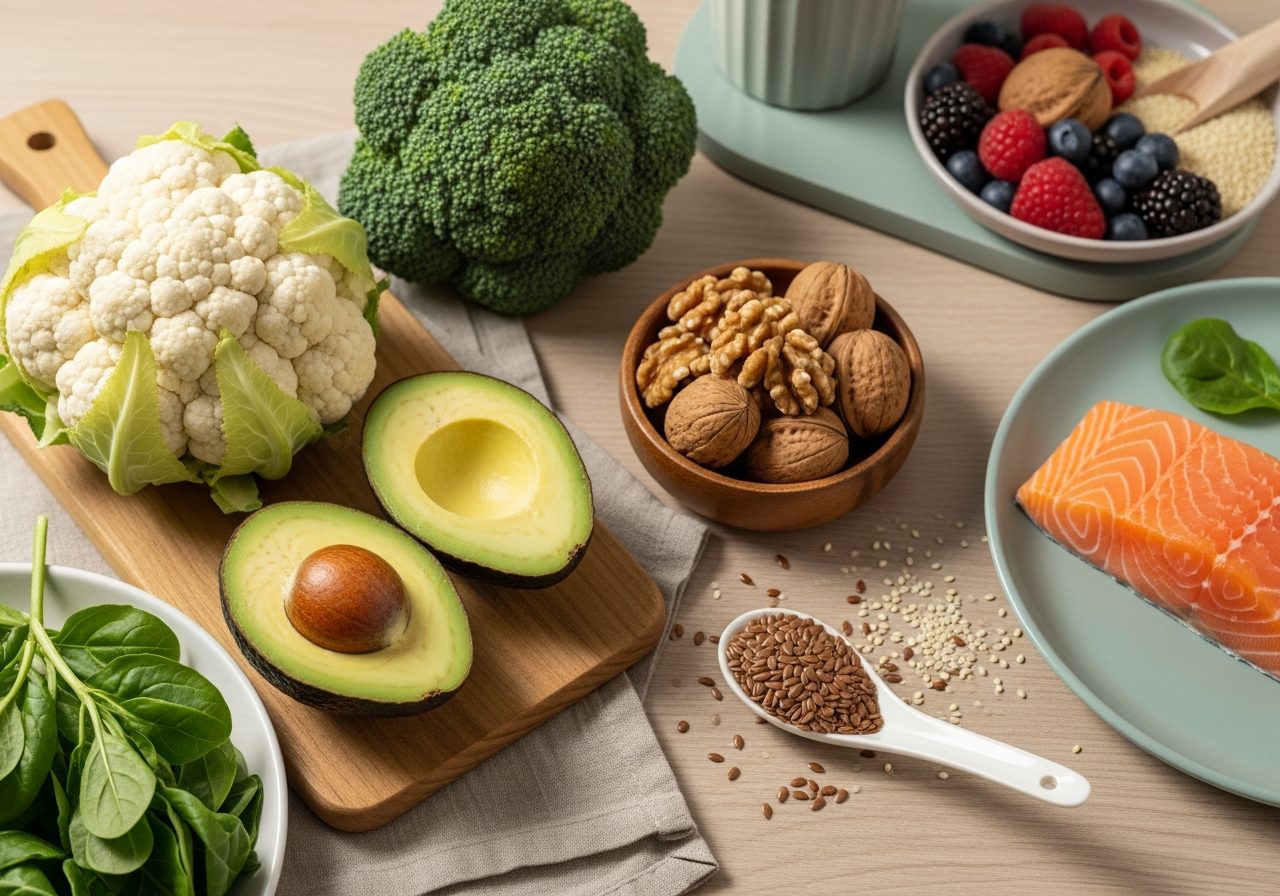
The fats that matter most are the unsaturated ones: avocado, extra-virgin olive oil, nuts, seeds, and fatty fish. Whole food sources of saturated fat (eggs, grass-fed meat in moderate amounts) also contribute to hormone synthesis, though the emphasis should stay on the unsaturated category. The goal is not to eat fat indiscriminately but to give the body consistent building material.
A half avocado, a tablespoon of extra-virgin olive oil, or a small handful of walnuts at most meals is enough to make a real difference over time. If you have been avoiding fat in the name of weight management, Julia's piece on Good Fats Are Essential addresses that directly. The relationship between fat, hormones, and body composition is not what most people expect.
Omega-3 Fatty Acids and Inflammation
Omega-3 fatty acids, found in wild salmon, sardines, walnuts, ground flaxseed, and chia seeds, work through a different mechanism. Rather than building hormones directly, they reduce the systemic inflammation that disrupts hormone receptors and impairs insulin sensitivity.
Insulin resistance is one of the most underrecognized drivers of hormonal imbalance in women. When cells stop responding properly to insulin, the resulting blood sugar fluctuations put constant stress on the adrenal system, elevate cortisol, and interfere with the pituitary's ability to regulate sex hormones downstream. Omega-3 fats help interrupt that cycle.
Practical inclusion looks like: wild salmon two to three times per week, a tablespoon of ground flaxseed daily, walnuts as a snack several times per week, or a high-quality fish oil supplement when food sources are inconsistent.
Fiber, the Gut, and the Estrobolome
This is the connection most women are missing, and it is the reason gut health and hormone health cannot be treated as separate conversations.
The gut microbiome contains a specialized community of bacteria known as the estrobolome. These bacteria produce an enzyme (beta-glucuronidase) that determines whether estrogen that has been processed by the liver gets reabsorbed into the bloodstream or excreted. When gut microbial diversity is poor, beta-glucuronidase activity rises, more estrogen gets recirculated rather than cleared, and the body accumulates hormones it was trying to release.
Dietary fiber is the primary input that feeds and diversifies the estrobolome. Beans and lentils, oats, berries, flaxseeds, and a variety of vegetables all contribute. Diversity of fiber sources is as important as total quantity, because different bacterial strains thrive on different substrates.
This is also why fermented foods matter for hormone balance, not just digestion. Jolie's clients who have worked through the fermented foods for gut health guide often notice hormonal benefits alongside digestive ones, because a more diverse microbiome handles estrogen metabolism more efficiently. And the broader relationship between gut microbiome diversity and overall health is where this story starts.
Flaxseeds, Sesame Seeds, and Phytoestrogens
Flaxseeds and sesame seeds contain lignans, a class of phytoestrogens. Phytoestrogens are plant-derived compounds that interact weakly with estrogen receptors. They can exert a mild estrogenic effect or, in some contexts, compete with stronger estrogens for receptor binding. The National Institute of Environmental Health Sciences describes phytoestrogens as naturally occurring substances with hormone-like activity, noting that foods like soy and flaxseed are among the most studied sources.
For women in perimenopause or postmenopause, phytoestrogens from whole food sources may offer modest support for hot flashes and mood shifts. For women in their reproductive years, the lignan content in flaxseed also contributes to the fiber base that feeds the estrobolome.
One to two tablespoons of ground flaxseed daily is a practical starting point. Whole seeds pass through largely intact, so grinding is important. Stir into oatmeal, blend into smoothies, or mix into salad dressings.
Blood Sugar Stability as Hormone Support
Consistent blood sugar is one of the quietest and most powerful levers for hormone balance. Every time blood sugar swings high and crashes, the adrenal glands release cortisol to compensate. Chronic cortisol elevation then interferes with progesterone production (cortisol and progesterone share a precursor molecule called pregnenolone, and when cortisol demand is high, progesterone production gets shorted), disrupts sleep architecture, and keeps the body locked in a prolonged stress response.
Foods that stabilize blood sugar (protein at every meal, complex carbohydrates over refined ones, fat and fiber alongside each meal, no prolonged fasting without intentionality) do more for hormones than most supplements. The Office on Women's Health notes that avoiding foods and drinks with high sugar content in the two weeks before a period can meaningfully lessen premenstrual symptoms, which reflects how closely hormone fluctuations and blood sugar are linked.
The mood-food connection is also real. Julia explores this in Food and Mood. The link between what you eat and how you feel an hour later is the same blood sugar and cortisol mechanism at work in the hormone conversation. Jolie's guide to keeping your blood sugar stable is a natural next read for anyone working through this area.
Foods That Help Balance Hormones: Building a Daily Pattern
No single food is a hormone cure. The pattern across meals and weeks is what creates change. A practical starting framework:
- Build most meals around vegetables, including cruciferous varieties, with protein and a healthy fat
- Include one to two tablespoons of ground flaxseed or chia daily
- Eat oily fish two to three times per week
- Add a fermented food (plain yogurt, kimchi, sauerkraut) daily once gut tolerance allows
- Keep refined sugar and alcohol to a minimum, as both stress the liver's estrogen-processing capacity and deplete the B vitamins involved in hormone metabolism
- Prioritize fiber variety over fiber supplements, as whole food sources feed a broader range of gut bacteria
Consistency over several weeks is what allows the estrobolome to shift, the liver to work more efficiently, and inflammation to come down. The body responds to patterns, not single meals.
Hormone Balance Starting in Jersey City, NJ
Many of Jolie's clients from the Hudson County area come in with the same story: eating reasonably well but feeling off in ways that standard bloodwork does not fully explain. Food is often part of the picture, and so is sequence. A liver already stressed by a high-sugar diet cannot efficiently process estrogen regardless of how many cruciferous vegetables get added. A gut depleted by antibiotic overuse cannot build the estrobolome overnight.
The Jolie Method begins with food as the foundation and works outward from there. If you are in Jersey City and ready to understand what your body is communicating, this is where the conversation starts.
Begin Here to explore working with Julia one on one.
Looking for personalized, science-based support in Jersey City? Explore Jolie's wellness programs in Northern New Jersey.