
Menopause
Foods That Are Good for Gut Health in Weehawken, NJ
April 28, 2026 · Julia Erickson
Foods That Are Good for Gut Health in Weehawken, NJ
Your gut is running one of the most complex operations in your body. Trillions of microorganisms are breaking down food, training your immune system, producing neurotransmitters, and sending signals to your brain. What you eat every single day is the most powerful lever you have to shape that ecosystem. Clients in Weehawken ask me this question all the time: which foods should actually be on my plate if I want to support my gut? The answer goes well beyond yogurt and probiotic supplements.
The foods that are good for gut health fall into a few key categories, each doing something distinct for your microbiome. Think of your gut bacteria as a garden: some foods are the fertilizer that helps beneficial microbes multiply, others deliver structural support that reinforces the gut lining itself, and others bring a diversity of plant compounds that feed strains you never knew you had. You need several of these categories working together for the system to thrive.
Which Foods Are Good for Gut Health, and Why
Your gut microbiome is as unique as your fingerprint. According to researchers at the Mayo Clinic, the diversity of your gut bacteria depends largely on the variety in your diet. A narrow, processed diet starves the beneficial bacteria and creates space for opportunistic strains to take hold. A broad, whole-foods diet does the opposite: it feeds a wider community of microbes, which in turn supports immune regulation, mood stability, and consistent digestion.
The target that comes up in research again and again is 30 different plant foods per week. That includes fruits, vegetables, whole grains, legumes, nuts, seeds, and herbs. It sounds like a lot until you realize that garlic, onion, leeks, and asparagus can all appear in one meal. Variety is the strategy, not volume of any single food.
Prebiotic Foods: The Fertilizer Your Gut Bacteria Need
Prebiotics are plant fibers that your stomach and small intestine cannot break down on their own. They pass intact into the colon, where beneficial bacteria ferment them and produce short-chain fatty acids. Those short-chain fatty acids nourish the cells lining your colon, reduce intestinal inflammation, and support healthy immune signaling throughout your body.
The allium family is one of the richest sources of prebiotic fiber, particularly inulin and fructooligosaccharides. Garlic packs the most prebiotic punch per gram, containing 9 to 16 grams of inulin per 100 grams dry weight. Onions and leeks are easier to eat in larger quantities and deliver inulin consistently in cooked dishes without requiring much planning. A base of sauteed onion and garlic in soups, stews, or grain bowls gets this fiber into your diet daily without any additional effort.
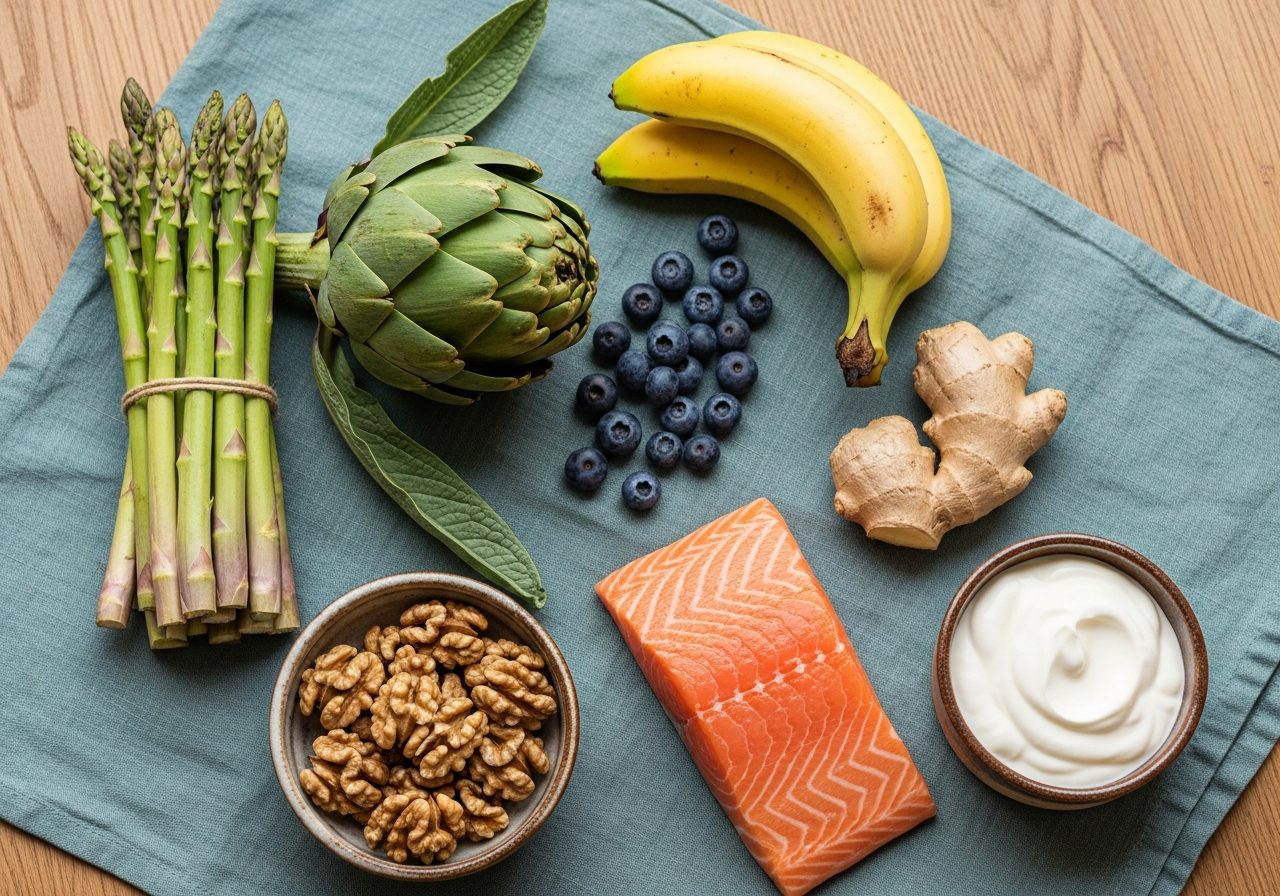
Asparagus is another standout prebiotic source, easy to roast in olive oil or add raw to salads. It contains inulin as well as folate and vitamins A, C, and K, making it one of the most nutrient-dense prebiotic foods you can eat regularly.
Bananas deserve a specific mention. Less-ripe bananas, still slightly green at the tip, are higher in resistant starch, a type of prebiotic fiber that studies have linked to increased Bifidobacterium counts in the colon. As a banana ripens fully, its starch converts to simple sugars. Keeping a few greenish ones in your rotation is a simple way to boost prebiotic diversity without any extra effort.
Artichokes offer the highest prebiotic inulin content per serving of any common vegetable. They take a bit more preparation time, but a simple steamed artichoke with olive oil and lemon is one of the most effective gut-supportive meals in the toolkit. If fresh artichokes feel like a weekend endeavor, jarred or canned artichoke hearts in water work well added to salads or grain bowls.
Polyphenol-Rich Foods: A Prebiotic You Did Not Know You Were Eating
Polyphenols are plant compounds found in colorful berries, dark chocolate, extra-virgin olive oil, green tea, and deeply pigmented vegetables. Up to 85% of polyphenols are not absorbed in the small intestine. They travel intact to the colon, where they selectively stimulate the growth of beneficial bacteria including Bifidobacterium, Lactobacillus, and Akkermansia muciniphila.
This is meaningful because polyphenols produce a gut microbiome shift that is distinct from fiber alone. Studies have documented meaningful increases in Bifidobacterium following regular blueberry consumption, tied specifically to the polyphenols rather than the fiber content of the fruit. Blackberries, raspberries, and dark cherries carry similar compounds and contribute to the same selective growth effect.
Extra-virgin olive oil is a polyphenol-rich staple that many people underuse. The phenolic compounds in quality olive oil carry anti-inflammatory properties that benefit the gut lining directly. Using it as your primary cooking fat rather than reserving it for finishing drizzles is a practical shift with real consequences.
Cacao deserves its own mention. Daily dark chocolate, 70% cacao or higher, has been shown in clinical trials to modify gut microbial metabolism in healthy adults. A small square with breakfast is not an indulgence to feel guilty about. It is a legitimate gut health practice, particularly when combined with the rest of a whole-foods approach.
Leafy Greens and Cruciferous Vegetables: The Gut's Daily Workhorse
While prebiotic and polyphenol foods get the most attention, leafy greens do an enormous amount of consistent work for the gut. They bring folate, magnesium, and insoluble fiber that keeps transit time regular. Kale, Swiss chard, spinach, arugula, and collard greens each contribute slightly different nutrients, which is why rotating through them across the week is more useful than eating the same one daily.
Cruciferous vegetables like broccoli, cauliflower, Brussels sprouts, and cabbage provide glucosinolates, compounds that support liver detoxification while contributing fermentable fiber to the colon. When you roast Brussels sprouts and eat a cup of them, you are supporting both phases of liver detox and feeding a diverse bacterial community in your gut simultaneously.
Eating the rainbow is not just a visual principle. Different pigments correspond to different phytonutrients, and different phytonutrients feed different bacterial strains. Red cabbage, orange carrots, yellow squash, green kale, and purple beets each contribute distinct compounds that a diet of neutral-colored processed foods simply cannot replicate. The principle of eating your plants first ensures this variety lands on your plate consistently, even on rushed days.
Omega-3 Sources: Building a More Diverse Microbiome
Omega-3 fatty acids are one of the most underappreciated contributors to gut health. Research published in Scientific Reports found significant correlations between circulating omega-3 levels and microbiome alpha diversity in adult women. Separately, clinical research found that adding walnuts to the diet significantly increased the evenness of gut microbial communities, an effect attributed to the omega-3 content alongside polyphenols and antioxidants in the nut itself.
Fatty fish is the most bioavailable omega-3 source: wild salmon, sardines, and mackerel provide EPA and DHA directly, the two forms your body can use most efficiently. Two servings per week is a reasonable starting point for most adults.
For plant-based omega-3s, walnuts, chia seeds, and ground flaxseed are the most reliable options. Chia seeds and flax also add soluble fiber, giving you a prebiotic benefit alongside the omega-3 delivery. A tablespoon of ground flax in a morning smoothie or over oatmeal is a small addition with a meaningful return over time.
Bone Broth: Supporting the Gut Lining
Bone broth occupies a slightly different category from the others. Rather than feeding gut bacteria, it provides amino acids, particularly glutamine, glycine, and proline, that support the structural integrity of the gut lining. When the lining becomes permeable, partially digested particles trigger immune responses that can manifest as fatigue, skin reactions, or generalized inflammation.
According to Cleveland Clinic, a healthy gut requires not only a diverse microbial community but intact barrier function. Bone broth supports that barrier by providing the raw materials for cellular repair. It is not a cure for serious gut damage, but incorporating it regularly as part of a whole-foods diet offers gentle, consistent support to the structural layer.
A batch of chicken bone broth simmered overnight and used as the base for soups, grains, or sipped on its own a few times a week is a practical way to integrate it. The recipe for homemade chicken bone broth is a Jolie staple for exactly this reason.
Fermented Foods: Where These Categories Come Together
Fermented foods bring live bacteria directly into the gut environment, adding to the microbial population rather than just feeding existing residents. They are an important part of the picture, but they work best when supporting a gut that already has good microbial diversity from fiber and prebiotic foods. Without the prebiotic layer, probiotic bacteria often cannot persist for long.
For a full breakdown of the best fermented foods, how they work in the body, and how to add them without disrupting digestion, see the fermented foods for gut health guide from Caldwell, NJ, which covers this topic in depth as a companion to this post.
A Simple Weekly Framework
You do not need to eat all of these foods every day. A more useful approach is building a weekly rhythm that covers the major categories without requiring meal-by-meal planning:
- Alliums daily: garlic or onion as a base in at least one cooked dish
- Leafy greens at least four days a week, rotating through varieties
- One prebiotic-rich vegetable (asparagus, artichoke, or leeks) two to three times a week
- Berries or dark cherries most days, fresh or frozen
- Omega-3 fish twice a week, or walnuts and chia seeds daily for plant-based variation
- Bone broth a few times a week, particularly during seasons when digestion feels sluggish
- Dark chocolate daily in a modest portion, 70% cacao or higher
The goal is diversity. Each food brings a different compound, a different fiber structure, a different set of bacterial stimulants. The wider the variety, the more resilient the microbial ecosystem.
For Jolie's clients in the Weehawken area working on digestive health, building these patterns is often the foundation work before any more targeted intervention makes sense. The gut is responsive to what you feed it, consistently, over time. These foods are where that conversation starts.
Looking for personalized, science-based support in Weehawken? Explore Jolie's wellness programs in Northern New Jersey.